Showing posts with label politic. Show all posts

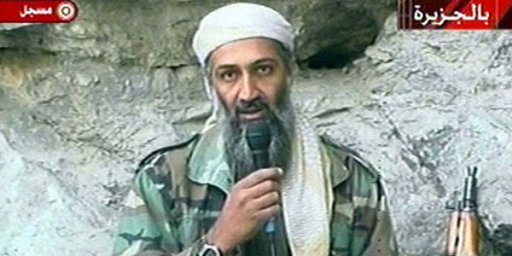
This is the U.S. Technology 'Hunting' Osama bin Laden

Posted by newbie Wednesday, May 4, 2011 0 comments

Most-wanted fugitives United States (USA), Osama bin Laden, known for clever hide. Here's technology that never used the U.S. to pursue this fugitive.
The U.S. has to chase Osama bin Laden since the World Trade Center ago (9 / 11) and the many ways that was fruitless. Here are ways that once made the United States to pursue bin Laden.
Tracking model biological
Geographers University of California-Los Angeles (UCLA), Thomas Gillespie and John Agnew makes the terrorist leader of the search model using the same technique to track the animals and migratory patterns.
Murtaza Haider of Ted Ryerson Unversity School of Management said,

more>>>

Gaddafi calls for Nato negotiations

Posted by newbie Saturday, April 30, 2011 0 comments
Muammar Gaddafi says he wants to negotiate with Nato powers, as air strikes hit government complex in Libyan capital
Muammar Gaddafi called for a mutual ceasefire and negotiations with Nato powers in a live speech on state TV early on Saturday, while Nato bombs struck a government complex in the Libyan capital.
The targeted compound included the state television building, which was not damaged. Gaddafi spoke from an undisclosed location.
In his rambling pre-dawn speech, the Libyan leader appeared subdued but defiant, repeatedly pausing as he flipped through handwritten notes.
more>>>

Syrians protest as unrest spreads

Posted by newbie 0 comments
• 24 killed in Deraa after thousands take to streets
• UN approves inquiry into government violence
Thousands of Syrians defied their government's bloody attempts to suppress protests, braving gunfire from security forces to demonstrate in Damascus and across the country.
Initial reports said at least 24 people had been shot dead, most of them in the opposition stronghold of Deraa, where villagers tried to break through the security cordon to relieve its besieged population.
Further deaths were reported in Latakia and Homs after the security forces opened fire on demonstrators. There was news of protests in 50 towns and villages including Hama, Aleppo, the coastal cities of Latakia and Banias, Deir Ezzor in the east, and Qamishli in the north-east. Unrest was also reported from the Syria-Jordan border, which is straddled by the Haurani tribes.
Despite the government crackdown, the demonstrations – many starting as Friday worshippers left mosques – appeared to be at least as big as last week. Even more significantly, activists said, the protests spread closer into the centre of Damascus.
Demonstrators in the neighbourhoods of Barzeh, Midan, Bab Srejeh and Hajr al-Aswad faced security forces backed up by soldiers for the first time. Two witnesses in Midan told the Guardian that a crowd of 4,000 protesters who came out of Zain al-Abideen and Hassan mosques were dispersed by tear gas and security forces with batons. "I counted 17 buses of security," said one who asked not to be named.
Another said tear gas and sound bombs were used and the street to the main hospital was closed. He said shabiha [gangs connected to the ruling family] were terrorising the neighbourhood well after the demonstration was dispersed.
more>>>

Gaddafi troops captured in Tunisia

Posted by newbie 0 comments
Attempt by Libya loyalist soldiers to retake a key crossing from rebel hands leads to border skirmish with Tunisian forces
The Libyan civil war has briefly spilled into Tunisia as the west of the country saw heavy fighting on two fronts and Nato reported that Muammar Gaddafi's forces were laying anti-shipping mines in the sea off Misrata.
Loyalist troops made incursions over the border into Tunisia in a battle to retake a key crossing from rebel hands, drawing condemnation from Tunis.
Libyan soldiers were captured by Tunisian forces after firing indiscriminately in clashes that lasted about 90 minutes, according to reports. Witnesses said three Tunisians were injured.
more>>>

Obama vows swift post-tornado aid

Posted by newbie 0 comments
President visits wrecked university city of Tuscaloosa in Alabama, the worst hit of seven states where 210 people died
Barack Obama has flown to the epicentre of one of the United States' worst tornado disasters to pledge federal support for recovery after 310 people were killed.
The president and his family visited the wrecked university city of Tuscaloosa in Alabama, the hardest hit of seven states that were blasted this week by tornadoes and storms that flattened whole neighbourhoods. It was the worst US natural catastrophe since Hurricane Katrina in 2005. In Alabama alone, 210 people lost their lives.
Approaching the airport in Tuscaloosa yesterday, Air Force One flew over the tornado strike zone, giving Obama and his family a clear view of a wide brown scar of devastation several miles long and hundreds of meters wide.
The president is eager to show that federal relief is on its way and that he is not taking the disaster lightly. His predecessor George Bush was fiercely criticised for what was viewed as a slow response to Hurricane Katrina.
White House spokesman Jay Carney said Obama "wants to put a spotlight for the rest of America on the suffering that a storm like this implies for so many families."
Recovery could cost billions of dollars and even with federal disaster aid it could complicate efforts by affected states to bounce back from recession. It will place an added burden on municipalities grappling with fragile finances.
Tornadoes are a regular feature of life in the south and midwest, but they are rarely so devastating. Deaths also were reported in Mississippi, Tennessee, Arkansas, Georgia, Virginia and Louisiana.
The tornadoes ravaged Alabama's poultry industry – the state is the country's third-largest chicken producer – and battered at least one coal mine and other manufacturers and industries.
The second-biggest US nuclear power plant, the Browns Ferry facility in Alabama, may be down for weeks after its power was knocked out and the plant automatically shut, avoiding a nuclear disaster, officials said.
Clothing company VF Designs said one of its jeanswear distribution centres in Hackleburg, Alabama, was destroyed and an employee killed.
At first light on Friday, state authorities deployed teams in Tuscaloosa, home to the University of Alabama, to help survivors still picking up the pieces after the tornadoes on Wednesday devastated homes and businesses.
The twisters, including one a mile-wide that cut a path of destruction, reduced houses to rubble, flipped cars and knocked out power and other utilities.
"We are bringing in the cadaver dogs today," said Heather McCollum, assistant to the mayor of Tuscaloosa, who put the death toll in the city at 42 but said it could rise. She said 900 people were injured.
Hundreds of people were left homeless by the tornadoes and stayed in shelters. A curfew would be renewed on Friday night to prevent looting, although there had been almost none, she said.
The city has been inundated with offers of help from around the country, McCollum said.
McFarland Boulevard, normally one of the busiest streets, was wrecked and largely blocked off and state troopers and city police patrolled its shattered shops and houses.
The storms left up to a million homes in Alabama without power. Because of damage to infrastructure and gas stations, Alabama and the neighboring state of Tennessee advised people traveling to affected areas to fill up their tanks with gas.
Water and garbage collection services were also disrupted in some areas.
Alabama's Jefferson County, which is fighting to avoid what would be the largest municipal bankruptcy in US history over a $3.2bn bond debt, suffered damage and 19 dead but said the storms would have little direct impact on its finances.
"It won't directly impact us in that the president has declared a national disaster which requires grants," county commission president David Carrington said.
The storm threw into turmoil the University of Alabama. Two students died off campus and administrators canceled final exams and postponed graduation until August.
Many students slept in dorm rooms without power overnight and large numbers were heading home on Friday. "Everyone is getting out," said Katie Bayless, 19, whose parents had driven through the night from Houston, Texas, to collect her.

Daimler profits roar on back of China

Posted by newbie 0 comments
Daimler follows trend for growing confidence in car industry and doubles first-quarter profits as Chinese sales rise 82%
Booming demand for luxury cars in China has helped Daimler double its profits in the first quarter of the year and highlighted a wider turnaround in confidence for automobile makers.
Sales of Mercedes-branded cars and sports utility vehicles (SUVs) increased by 82% in the world's most populous nation compared to 4% growth in western Europe and America.
The German-based carmaker reported earnings of €1.18bn (£1.05bn) compared with €612m in the same period of 2010, while revenues were up 15% at €24.7bn.
"We achieved excellent earnings in the first quarter. This puts us well ahead of our planning and confirms our positive outlook for the year 2011," said Dieter Zetsche, chairman of Daimler and head of the Mercedes division.
The strong performance confirms a trend highlighted by other companies recently, including Volkswagen, Volvo and particularly Ford, which had its best quarter for 13 years.
The industry has been in a parlous position since the banking crisis of 2008 triggered a global recession and a slump in car sales that led governments to introduce a "cash for clunkers" financial incentive scheme. Recent upsets have included the Japanese earthquake which has disrupted output among companies such as Toyota with major British production factories.
Daimler itself said it had been forced to write down €49m at its Daimler Truck division, which has a joint venture in Japan, and a further €29m at Daimler Financial Services. But the truck operation – the biggest in the world – generally performed very strongly, raising operating earnings from €130m in the first quarter of 2010 to €415m this year.
Overall, Daimler sold 15% more cars and commercial vehicles in the first three months of this year while Mercedes' operating profits rose 60% to €1.2bn.
Bodo Uebber, chief financial officer at Daimler, said there was no indication that demand in China for Mercedes would ease off in the near future and the group expected the marque to hit record sales of 1.2m cars this year helped by its top-of-the-range S-Class model. Similar trends – a burgeoning middle class seeking out luxury vehicles – can be seen in India.
However, the City was not impressed by Daimler's figures after far stronger than expected results from others. Daimler shares were trading down 2%.
Tim Schuldt, a car industry analyst at Equinet Bank, said: "While the first quarter was definitely a good quarter for Daimler, it also shows that it becomes more difficult for the company to surprise positively as expectations are high."
Volkswagen announced this week that it had tripled its profits in the first quarter, crediting mounting demand in China for its VW and Audi brands.
Volvo has also doubled its earnings and said its European orders were up by nearly 50% and its North American ones more than tripled, while Ford said US sales had risen by 16% as customers sought fuel-efficient vehicles such as the Escape. This helped Ford's total vehicle sales to reach 1.4m, up by 150,000 vehicles.
But some firms are still struggling. Spyker Cars – the owner of the Saab marque – has reported a net loss of €76.3m as it struggled to find cash to restart production at its factory in Sweden. Output has been at a standstill since earlier this month after Spyker ran out of money to pay Saab suppliers.
Spyker has been trying to interest a handful of Chinese carmakers to put up some cash for Saab, while China's state-owned SAIC now owns the MG brand and has just launched the new MG6 fastback.
The Society of Motor Manufacturers and Traders in Britain reported last week that 135,052 cars were produced in the UK last month – a 14.8% increase on the March 2010 figure.

'Al-Qaida members' held in Germany

Posted by newbie Friday, April 29, 2011 0 comments
Three men of Moroccan origin posed 'concrete and imminent danger' to country, according to officials
German police on Friday arrested three suspected al-Qaida members who officials say posed a "concrete and imminent danger" to the nation.
Authorities did not say whether the three had planned specific targets and offered few details, but security officials said that all three suspects were of Moroccan origin. They also said that two were arrested were in the western German city of Duesseldorf and one in nearby Bochum. The arrests were based on suspicion they were planning a terror attack, they said.
Local media reported that officers had seized large amounts of explosives when the three were arrested.
The arrests "succeeded in averting a concrete and imminent danger, presented by international terrorism," German interior minister Hans-Peter Friedrich said in a statement. They showed "Germany remains a target of international terrorists."
Germany has escaped any large-scale attack by an Islamic terror organisation, such as the Madrid train bombings of 2004 and the London underground attacks of 2005. But Germany's presence as part of the Nato coalition in Afghanistan has sparked anger and at least two major plots have been thwarted or failed in Germany before they could be carried out.
The suspects had been under surveillance since November when Germany increased security across the country in response to heightened terror threat warnings in Europe, but authorities only had enough evidence to launch an official criminal investigation starting 15 April, Friedrich said in a statement.
Federal prosecutors said earlier that they had ordered federal police to arrest the trio, but gave no further information about the timing or location of the arrests. Officials were planning a news conference for Saturday.
A US official speaking on condition of anonymity said a team picked up three people in a raid on suspicion they were planning an attack with explosives.
"Our concerns about threats in Europe had a number of different threads and strands, some of which have been disrupted by good intelligence and law enforcement work by the relevant services," another US official said.
"There have been five disrupted plots in Europe during the past four years including a credible plot in Germany in 2007 all of which demonstrate Pakistan-based al-Qaida's steadfast intent to attack the US and our allies."
Duesseldorf, a city of 600,000, has one of the largest Moroccan immigrant communities in Germany. It is to host the Eurovision Song Contest on 14 May, which is expected to draw hundreds of thousands of spectators.
Prosecutors said the three alleged terrorists would be brought before a judge Saturday who will decide whether they are to remain in detention pending a trial.
Germany raised its security posture in November after receiving information from its own and foreign intelligence services that led authorities to believe a sleeper cell of some 20 to 25 people may have been planning an attack inside the country or in another European nation.

Uganda rebellion gathers pace despite crackdown

Posted by newbie 0 comments
Violent response to protests led by Kizza Besigye has fuelled rioters' determination to throw out President Yoweri Museveni
Riots have swept across the Ugandan capital, Kampala, in the biggest anti-government protest in sub-Saharan Africa so far this year.
Security forces have launched a brutal crackdown, opening fire on unarmed civilians with live rounds, rubber bullets and teargas. Two people have been killed, more than 120 wounded and around 360 arrested. Women and girls have been among those beaten, according to witnesses.
Two weeks of growing unrest – sparked by rising food and fuel prices – have gained fresh impetus after the violent arrest of the opposition leader Kizza Besigye on Thursday. Critics say President Yoweri Museveni, in power for 25 years, is losing his grip. They claim his wildly disproportionate crackdown on Besigye's "walk to work" protests smacks of panic and is sowing the seeds of popular revolt.
"I thought the police were going to kill me," said Andrew Kibwka, 18, after police with heavy sticks rained blows on him. "I was telling them I'm harmless but they just carried on. I did nothing to provoke them. They beat me because I was running away."
Some point to the political earthquakes in Tunisia, Egypt and Libya, and wonder if the aftershocks could reach tyrannies south of the Sahara. Already there are pockets of unrest from Burkina Faso to Senegal to Swaziland. Even South Africa, reputed anchor of the continent, is tormented by deadly protests over poor public service delivery.
In Uganda there is an inchoate revolution struggling to be born. Protests have spread to several towns, leaving seven people dead and hundreds in jail. The riots, in which roads have been barricaded with burning tyres and vehicles pelted with rocks, mark a new level of defiance. Facebook and Twitter, which the government unsuccessfully tried to block, are reverberating with dissent. Museveni's heavyhanded attempts to put out the fire only appear to be fanning its flames.
The subversion here began on 11 April with nothing so spectacular as an act of self-immolation: rather, a defeated politician and half a dozen allies walking down a street. The walk to work campaign is intended to highlight the soaring prices of fuel and food, which leave many Ugandans unable to afford public transport.
If Besigye, who has lost three elections to Museveni, had been ignored the piece of theatre might have fizzled out. Instead riot police blocked the group, unleashed teargas and arrested Besigye. At a stroke this waning establishment figure was reborn as a hero of resistance.
Ssemujju Ibrahim Nganda, an MP-elect for Besigye's Forum for Democratic Change, recalled the innocuous beginnings of walk to work. "We never intended to have a Tahrir Square to remove Museveni," he said. "We just wanted a reawakening of the people. We started walking, the simplest thing on Earth, and Museveni said you can't."
At the third protest Besigye was hit in the hand by a rubber bullet. Images of him with hand bandaged and in a sling gave the opposition a publicity coup. With each walk he has attracted more followers like a pied piper.
Nganda, who was jailed for five days for taking part in a walk, said: "When you start a campaign you never know what the response will be. I didn't know we'd have any people following; nobody knew. Museveni's brutal reaction is what raised its profile beyond our expectations. It's dominating the media, the opposition, even Museveni himself."
The 37-year-old said Ugandans would prove as determined as their north African counterparts. "I don't think when the Tunisians started they knew it would be the end of Ben Ali, or when the Egyptians started they knew they would get rid of Mubarak. Nobody can be sure what shape it will take in Uganda but we are going to continue until Museveni leaves."
Besigye, 54, who was Museveni's personal doctor during the bush war against former president Milton Obote, was detained again in Kampala on Thursday after police smashed their way into his vehicle and shot pepper spray into his eyes, potentially causing permanent damage to his sight.
Just an hour earlier he had admitted he was hesitant to draw close comparisons with Egypt and Tunisia. "The only parallel goes to the extent that people are discontented with what is going on and their governments are non-responsive," he said. "There is a loss of trust between the regime and the people. I think that is the only parallel I can see. How this popular discontent is channelled is always governed by the unique qualities of governments."
Asked if he was prepared to die for the cause, Besigye replied: "I am not setting out to become a martyr of anything. I am simply asserting my citizen's rights, which are inherent, which are not offered by the state and which I am determined to defend at all costs."
Commodity prices could be the spark in a Ugandan tinderbox of resentment over corruption and neglected public services. Museveni has refused to copy neighbouring Kenya by cutting taxes on fuel. And with unfortunate timing his recent re-election campaign is estimated to have cost $350m (£210m) with a further $1.3m (£781,000) allotted to his inauguration ceremony, while a bill for new military fighter jets stands at $740m (£445m).
Public anger was burning on a street where no car was safe from flying stones. Robert Mayanja, a self-described activist, said: "What they are doing now shows that Museveni rigged the last election. If you look at Uganda, why should we vote for him after 25 years? We have high prices, we have hospitals without medicine."
Mayanja, 31, said a repeat of the revolts in Egypt and Tunisia was "definitely" possible. "What we are seeing here are people who are not armed but are taking a stand against armed forces," he said. "People are ready. It's just a question of time.
"We know they are going to arrest many people and put them in torture chambers. We know this regime has expired. These are the signs."
In Ntinda district angry youths shouted and hurled stones and chunks of concrete at passing cars. On one corner a man ran up to a council vehicle as it drove by and smashed the driver's window with a rock, raising cheers from onlookers.
A teacher, who gave his name only as Nixon, 32, said he could not imagine an Egypt-like revolt in the short term. "But in the long term I believe it can happen," he said. "The military is still strong and many of the soldiers are unwilling to turn to the side of the people. But in time they might get tired of beating the people.
"I really look forward to it. As your friends are beaten and arrested, the professionals need to come out and organise the people."
A young population often seen as politically apathetic has reached unexpected levels of activism. People who used to bolt at the first whiff of teargas are losing their fear. But there are serious doubts over whether a critical mass of Ugandans have the will or the means to drive the president out. He retains a vice-like hold on the military and police.
Rosebell Kagumire, a journalist blogging and tweeting the political crisis, said: "Most people on Twitter are anti-Museveni but there is not a firm opinion on what to do now. They don't expect him to go anywhere soon. He owns the army and his government won't stop at anything.
"It's hard to get people to believe going to the streets will change anything, especially when they know the government is prepared to kill half of them. Ugandans have not reached that level yet."
Museveni, whose recent election victory has been denounced as fraudulent, is confident he can avoid the fate of Arab leaders. "Nobody can take over power through an uprising," he said recently. "Whoever thinks like that, I pity such a person."
His spokesman, Tamale Mirundi, added: "In Tunisia and Egypt democracy was lacking; in Uganda we elect our leaders at every level. The president organised and campaigned in transparent elections. Besigye cannot say he was cheated and that is why he is jumping on oil prices."
Mirundi played down the power of the internet. "Go to the villages. How many people can access Facebook? Very few. Who knows Facebook? Very few. Facebook cannot create a politician in our country. Facebook cannot create a problem."
Yet every day in Uganda, and elsewhere in Africa, new people are connecting and interacting for the first time. "Uganda is sitting on a time bomb," tweeted Richo Nuwagaba . "It's just a matter of time. I am scared."